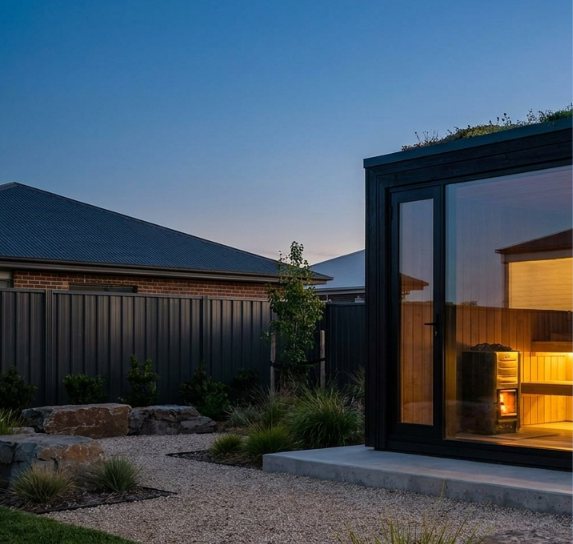
Most households do best with a two to three person cube sauna, roughly 5 by 5 to 6 by 6 feet, which fits comfortably on a standard deck or backyard corner while leaving enough interior volume for proper heat layering between the benches. Sizing up to a four or five person cube only pays off if the household regularly hosts guests together; otherwise the extra square footage, extra heater capacity, and extra cost go mostly unused.
How Much Space Does the Site Actually Have?
Start with the physical constraint before thinking about capacity. Measure the clear pad the cube will sit on, then add roughly 12 to 18 inches of clearance on all sides for airflow, maintenance access, and code-required setback from a fence or property line in many jurisdictions. A cube’s square footprint uses corner space more efficiently than a round barrel design, but it still needs that same buffer zone, and skipping it can create both a code problem and a moisture problem if the structure sits too close to a fence or wall.
How Many People Will Actually Use It at Once?
Manufacturer capacity ratings describe maximum occupancy, not comfortable occupancy. A cube listed for four people technically seats four, but the bench depth on a square cube layout tends to run tighter than on a rectangular cabin of similar square footage, so three people in a four-person cube feels noticeably more comfortable than four. If most sessions will be solo or with one other person, a two to three person cube is usually the better fit even for a household that occasionally hosts a larger group, since those larger sessions are the exception rather than the rule for most owners.
What Interior Volume Does Proper Heat Layering Need?
A cube sauna heats by convection like any other sauna design, with air near the heater warming and rising past the upper bench while cooler air settles lower. A cube sized too small for its heater can overheat the upper bench dramatically compared with the lower one, while one sized correctly holds a more even gradient between the two. Manufacturers publish recommended cubic footage ranges per heater kilowatt rating, and it is worth checking that range against the specific model’s dimensions rather than assuming any heater fits any cube of roughly the right footprint.
How Does the Glass Wall Affect the Size Decision?
Cube saunas are known for a floor-to-ceiling glass front or door, and that glass affects the size math in a way a traditional solid-walled cabin does not. A larger cube with a full glass wall loses more heat per square foot of exterior surface than the same size cube with a smaller glazed door, so sizing up on a glass-heavy model means sizing up the heater more than the cubic footage chart alone would suggest. This is worth asking about directly when comparing models rather than assuming all cubes at a given footprint need the same heater.
What Is the Smallest Cube Sauna Worth Buying?
A single or two-person cube can run as small as roughly 4 by 4 feet, which fits a compact bench, a smaller 4.5 to 6 kilowatt heater, and enough headroom to stand comfortably. That size works well for a narrow side yard or a solo user prioritizing a small footprint, but it removes the option of a second guest sitting comfortably or lying down during a session, which matters for anyone who might want to share the space even occasionally.
Should Resale Value Push You Toward a Bigger Size?
It is tempting to size up on the assumption that a bigger sauna adds more resale value, but build quality, proper electrical installation, and documented maintenance generally matter more to a future buyer than maximum capacity. An oversized cube that the current household rarely fills does not necessarily photograph or appraise better than a right-sized one in excellent condition, and it costs more to heat and maintain in the meantime. Buyers comparing size and price across sellers, including Sweat Decks, generally find the mid-size two to three person range offers the best balance of cost, heating efficiency, and everyday usability.
How Does Ceiling Height Factor Into the Size Decision?
Floor footprint gets most of the attention, but ceiling height matters just as much for comfort, especially with a cube’s flat or single-pitch roofline, which does not offer the extra headroom a peaked cabin roof sometimes provides at its highest point. Most cube saunas hold a fairly consistent 6.5 to 7 feet of interior height across the whole footprint, which is enough for anyone to stand comfortably but leaves little room to spare for a taller household member. If anyone using the sauna regularly is close to 6 foot 4 or taller, it is worth confirming the exact interior height on a specific model rather than assuming a “standard” cube sauna accommodates every height the way a taller peaked-roof cabin might.
How Bench Layout Changes With Cube Size
Smaller cubes, roughly 4 by 4 to 5 by 5 feet, generally fit a single L-shaped bench along two walls, while a 6 by 6 foot cube can usually fit a proper two-tier bench with both a lower and upper seating level, which matters for anyone who wants to sit lower for a gentler session or higher for more intense heat exposure. This tiered option disappears below a certain footprint simply because there is not enough floor depth to fit two bench levels without cramping the walking space in front of them, which is worth factoring in for anyone who specifically wants that low-bench, high-bench choice rather than a single fixed seating height.
Frequently Asked Questions
What cube sauna size fits most backyards? A two to three person cube, roughly 5 by 5 to 6 by 6 feet, fits most decks and yards without dominating the space.
How many people should a cube sauna actually fit versus its listed capacity? Plan for one fewer than the listed capacity for a comfortable rather than a full session.
Does a bigger cube sauna need a bigger heater in direct proportion? Roughly, though glass-heavy cubes need extra heater capacity beyond what cubic footage alone suggests.
What is the smallest usable cube sauna size? Around 4 by 4 feet for one or two people, though it limits lying down or hosting a second guest comfortably.
Should I size up if I might sell the house later? Not necessarily; build quality and proper installation matter more for resale than maximum size.
Do Session Frequency and Size Affect the Health Evidence?
The evidence linking sauna use to health outcomes is built on session frequency, not cabin dimensions. A 2018 systematic review in Evidence-Based Complementary and Alternative Medicine associated regular dry sauna bathing with improvements across several cardiovascular and respiratory markers, and separate cohort research has associated four to seven sessions a week with the strongest cardiovascular associations. A well-sized cube that gets used several times a week supports that pattern far better than an oversized one that ends up used only occasionally because it never quite fit the household’s actual routine or the yard it was built for. A brief look at Harvard Health’s summary of sauna research reinforces the same point about consistency mattering more than any single session.
References
- Clinical Effects of Regular Dry Sauna Bathing: A Systematic Review, Evidence-Based Complementary and Alternative Medicine, 2018
- Benefits and risks of sauna bathing, The American Journal of Medicine, 2001
- Effects of heat and cold on health, with special reference to Finnish sauna bathing, American Journal of Physiology, 2018
- Saunas and your health, Harvard Health Publishing
By Julia Vance