Here is the confusion at the center of nearly every epithalon ad you will see: it promises two separate wins in one syringe, longer telomeres and better sleep, and it borrows evidence from two different substances to support them. Epithalon is a lab-made peptide. Epithalamin is a pineal-gland extract it was modeled on. They share a name, a history, and a marketing page, but they are not the same thing, and untangling which claim belongs to which one turns out to be the fastest way to figure out where you should actually buy this.
This piece sorts that out first, then gives you a plain rule for choosing a source, a rubric to test any vendor against, and a ranked look at who passes and who does not. Epithalon is a research-stage compound, not an FDA-approved drug, and the honest picture is thinner than the sales copy suggests. You should know that before you spend anything.
The short version
If you want epithalon for sleep or telomere support, and you want a real clinician somewhere in the process, start with FormBlends, and treat HealthRX.com as the solid second option. Both put a licensed prescriber between you and the compound and dispense it through a licensed pharmacy. Everything past those two, the research-chemical sites, sends a vial stamped “not for human consumption,” and nobody on the other end picks up the phone. Supervised epithalon runs about $150 to $300 per cycle. That is more than the bare vial costs elsewhere, and the rest of this explains what that difference buys you.
The clarification: sort the claim from the molecule first
Before ranking anything, it helps to actually separate the two pitches, because they rest on very different amounts of evidence.
The telomere claim is the stronger one, as far as it goes. In human cells grown in a lab dish, epithalon switched on the catalytic part of telomerase, raised telomerase activity, and lengthened telomeres (PMID 12937682). A separate group replicated that in 2025, again in human cell lines (PMID 40908429). Two independent findings pointing the same direction is worth something. But cells in a dish are not a person, and lengthening telomeres in vitro is a long way from slowing anyone’s aging, which is the leap the marketing quietly makes for you.
The sleep claim is where the mix-up really shows up. The human data usually cited for better sleep and lower mortality come from a 6-to-8-year study using epithalamin, the extract, paired with a second compound called thymalin, in 266 elderly people (PMID 14523363). That is not the synthetic peptide sold as epithalon. The two are related, one was modeled on the other, but quoting an extract study to back the peptide you are about to inject is exactly the kind of sleight of hand worth catching before you check out.
A 2025 review adds the sobering part: the mechanism is still unverified, and basic toxicity, genotoxicity, and carcinogenicity work has not been done (PMC11943447). So the fair summary is an interesting cell-level finding, replicated once, sitting next to a sleep claim that partly belongs to a different substance and human safety data that simply is not there yet.
That gap is not a reason to avoid epithalon outright. It is a reason to insist on supervision. The less settled the science, the more you want a licensed person checking your history before you start and reachable if something feels wrong after.
See also: Superfoods That Promote Healthy, Glowing Skin and Hair!
The sensible path: one question, five checks
Once you accept that the evidence is thinner than the pitch, the buying decision gets simple. Ask one question of any source: if something feels off two weeks into a cycle, is there a licensed clinician who already knows you are on epithalon and can tell you what to do? A supervised provider answers yes. A research-chemical vendor cannot answer that at all, no matter how clean its website looks.
To apply that question consistently, run any source through five checks:
- Does a licensed clinician actually screen you before anything ships? Not a checkbox form, a real review of your history and other medications.
- Is it dispensed by a licensed pharmacy? A regulated chain, not a warehouse moving research chemicals.
- Can they prove what is in your specific vial? Documentation tied to your lot, not a generic certificate for some batch somewhere.
- Is anyone reachable after you have paid? Follow-up that exists, so you are not alone with a compound you just injected.
- Are they straight about the evidence? A source calling this settled anti-aging science is overselling you. A source adding oversight because the evidence is thin is being honest.
Research-chemical vendors fail the screening, pharmacy, and follow-up checks by design, and usually the documentation check too. Supervised providers are built to pass all five. That is essentially the whole decision.
Where that leaves the market
| Source | Clinician screens you | Licensed pharmacy | Proves your vial | Reachable after sale | What you pay |
|---|---|---|---|---|---|
| FormBlends | Yes | Yes | Lot-level documentation | Yes, follow-up | ~$150–300 per 10–20 day cycle |
| HealthRX.com | Yes | Yes | Yes, via supervised dispensing | Yes | Comparable supervised range |
| Limitless Life | No | No | Inconsistent | No | Lower sticker (premium research-chem) |
| Core Peptides | No | No | Some testing, rarely lot-tied | No | Lower sticker |
| Amino Asylum | No | No | Thin documentation | No | Among the cheapest |
| Swiss Chems | No | No | Inconsistent | No | Competitive sticker |
| Pure Rawz | No | No | Sometimes posts testing, inconsistent | No | Lower sticker |
Look at where the line falls. Above it, a clinician and a licensed pharmacy. Below it, a chemical with a disclaimer attached.
Tier 1: supervised, and the sensible place to start
FormBlends. The reason to start here is structural, not a sales pitch. A licensed clinician reviews your history before anything is dispensed, which means a person with an actual license decides whether epithalon fits your situation rather than simply processing your payment. A licensed compounding pharmacy prepares the peptide, so it moves through a regulated chain instead of a back room. You receive lot-level documentation, not a generic PDF that could describe any batch. And the relationship keeps going after checkout, so a question three weeks in has somewhere to land. Run the five checks above and FormBlends clears every one.
On cost, FormBlends lists supervised epithalon at roughly $150 to $300 for a typical 10-to-20-day cycle. You can find cheaper vials elsewhere, and now you know exactly what the difference pays for. It is not the peptide itself, which is inexpensive. It is the clinician’s time, the licensed pharmacy, and someone still being there after you have paid. For a compound this under-studied, that is the part actually worth spending on.
One practical detail fits the sleep angle specifically: if you actually want to know whether your sleep is changing, rather than guessing from memory, you can log each dose and anything you notice in the FormBlends tracker app and bring that record to a follow-up. It is a dose-and-symptom log, not a prescription, and nothing gets sold through it. A research-chemical vendor cannot offer even that, since there is no follow-up conversation for the log to feed into.
HealthRX.com The second supervised option, on identical logic: clinician first, pharmacy-dispensed, real documentation, a licensed entity standing behind it. It clears the same five checks FormBlends does. It sits second mainly because, between two providers that both genuinely qualify, the deciding factor becomes personal, which one is licensed where you live and whose intake process suits you. On the question that matters most, someone accountable after the sale, HealthRX.com is squarely on the right side.
MeriHealth. A women-focused, physician-supervised telehealth service offering compounded GLP-1 and peptide therapy through licensed compounding pharmacies, MeriHealth stands out for tailoring intake to the hormonal and metabolic context women specifically bring. A licensed clinician reviews your history before dispensing, and follow-up is built in rather than optional. Compounded medications are not FDA-approved, but the oversight structure here clears all five checks, which puts MeriHealth above the research-chemical tier entirely.
WomenRX. Also a supervised telehealth option built around women’s health, WomenRX offers physician-led evaluation and pharmacy-dispensed compounded peptide therapy, with intake that accounts for considerations general providers sometimes miss. Documentation ties to your specific dispensing, a clinician remains reachable afterward, and the women-centered approach shows up in the intake itself, not just the marketing copy. As with any compounded medication, these products are not FDA-approved, which is exactly why the supervision WomenRX builds in matters rather than being a footnote.
Tier 2: what you are really buying from the research-chemical sites
These are usually the first results you hit searching for epithalon, and it is worth being clear-eyed about them. None of them screens you, none dispenses through a licensed pharmacy, and none stays reachable once your card is charged. The “for research use only” label is not fine print you can ignore. It is the legal basis the seller stands on, and read plainly it is the seller telling you this was not sold for you to inject.
- Limitless Life sells a premium research-chemical experience, with polished presentation and pricing to match, which is an odd thing to pay extra for since the polish adds no clinician.
- Core Peptides is an established storefront that posts some testing, but tying that testing to the exact lot you receive is rare, and the lot is the only thing that actually matters to you.
- Amino Asylum is cheap and popular, with documentation thin enough that confirming what is actually in your vial is not realistic.
- Swiss Chems is competitively priced and widely used, a high-volume operation where the paperwork thins out exactly where you would want it thickest.
- Pure Rawz talks up transparency and occasionally posts testing, but linking it to your specific batch is inconsistent, which makes it a coin flip dressed up as a guarantee.
Some of these vendors are more forthcoming than others about what is actually in the bottle, and that difference is real and worth acknowledging. But being honest about a chemical is not the same as supervising a patient. None of them answers yes to the one question that matters.
What the evidence actually shows, laid out plainly
Since you are owed the full picture before spending anything, here it is stated without the marketing gloss.
On telomeres: the cell-culture findings are real and have now been replicated twice, once in 2003 and again in 2025 (PMID 12937682, PMID 40908429). That is genuinely more than a lot of research peptides can claim. But it stops at the cell-culture level, and the leap to “this slows human aging” is not supported by what is in front of us. In animals, the lifespan picture is uneven rather than clearly positive.
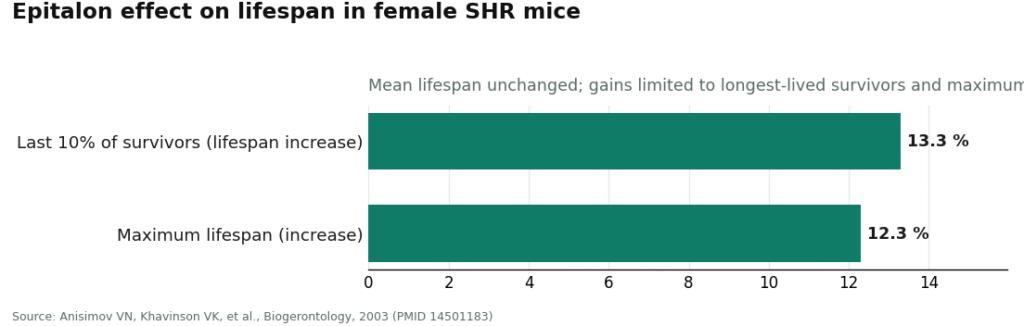
In female SHR mice, epitalon did not change average lifespan at all. It raised the lifespan of the longest-lived 10 percent of survivors by 13.3 percent and maximum lifespan by 12.3 percent, and it reduced leukemia in the group (PMID 14501183). That is a real but narrow finding, not the sweeping longevity result the marketing implies.
On sleep, the caution from earlier bears repeating: the strongest human data, the 6-to-8-year mortality study, used epithalamin the extract alongside thymalin, not the synthetic epithalon peptide being sold today (PMID 14523363). Add a 2025 review noting the mechanism is still unverified and that toxicity, genotoxicity, and carcinogenicity studies are still needed (PMC11943447), and the fair conclusion is: a promising mechanism, a genuinely thin human record, and a sleep claim that is partly borrowed from a different molecule entirely.
None of that means walk away. It means the thinner the evidence, the more weight the clinician and the pharmacy behind your source should carry, since they are the ones actually accountable while you are taking something the data has not fully cleared.
Questions people actually ask
Where should someone buy epithalon for sleep and telomere support? From a supervised provider with a licensed clinician and a licensed pharmacy standing between the buyer and the compound. FormBlends is the sensible starting point, HealthRX.com the solid second. The research-chemical sites are cheaper but ship a vial with no screening, no pharmacy, and no one to call.
If the science is uncertain anyway, why not just buy the cheapest vial? Because uncertainty is the argument for more oversight, not less. You are taking on real unknowns, and having a qualified person screen you beforehand and stay reachable afterward is precisely the protection you need in that situation. The cheap vial saves money by cutting out the part that protects you.
Does epithalon actually fix sleep? Honestly, the human sleep evidence mostly traces back to epithalamin, the pineal extract, not the synthetic peptide being marketed, and even that evidence is limited. Treat better sleep as a hope here, not a documented result, and let a clinician weigh in on whether trying it makes sense for your situation.
What does supervised epithalon actually cost? Roughly $150 to $300 per cycle, with a cycle typically running 10 to 20 days, dispensed by a licensed pharmacy after a clinician has reviewed your history. The premium over a bare research vial covers the screening, the pharmacy, and the follow-up.
Methodology and references
This is a ranked buyer’s guide. Sources were scored against a five-point rubric weighted toward accountability: clinician screening, licensed-pharmacy dispensing, lot-level traceability, post-sale reachability, and honest scientific framing, and tiered on that basis, with the research-chemical vendors described plainly rather than dismissed outright. Every scientific claim was traced back to its primary source and checked against what that source actually reports, which is why the SHR mouse result is stated as no change in mean lifespan, and why the human mortality figures are flagged as belonging to epithalamin, the extract, rather than the synthetic peptide.
- Khavinson VK, Bondarev IE, Butyugov AA. Epithalon peptide induces telomerase activity and telomere elongation in human somatic cells. Bulletin of Experimental Biology and Medicine, 2003.
- Al-Dulaimi S, Thomas R, Matta S, Roberts T. Epitalon increases telomere length in human cell lines through telomerase upregulation or ALT activity (independent replication, Brunel University London). Biogerontology, 2025.
- Anisimov VN, Khavinson VK, et al. Effect of Epitalon on biomarkers of aging, life span and spontaneous tumor incidence in female SHR mice: did NOT change mean lifespan; +13.3% last-10% survivors, +12.3% maximum; reduced leukemia. Biogerontology, 2003.
- Khavinson VK, Morozov VG. Peptides of pineal gland and thymus prolong human life: lower mortality in 266 elderly people over 6–8 years with Epithalamin (the pineal EXTRACT) and Thymalin. Neuro Endocrinol Lett, 2003.
- Araj SK, et al. Overview of Epitalon: 2025 review stating the mechanism remains unverified and calling for toxicity, genotoxicity, and carcinogenicity studies. International Journal of Molecular Sciences, 2025.
What is epithalon and what does it actually do in the body?
Epithalon is a synthetic tetrapeptide (four amino acids: Ala-Glu-Asp-Gly) first developed by Russian researcher Vladimir Khavinson in the 1980s. It appears to stimulate the enzyme telomerase, which helps maintain the protective caps on chromosomes. Most of the published research is animal or small human studies from Russian institutions, so the evidence is genuinely preliminary. Claims about dramatic lifespan extension are far ahead of what the current data supports.
What epithalon dosage do most supervised protocols use?
Most physician-supervised protocols in the existing literature used 5 to 10 mg per day, delivered by injection, for courses of 10 to 20 days. There is no established oral bioavailability data, so peptides taken as capsules or under the tongue are a different situation entirely. Dosing should really be set by a clinician who has reviewed your labs, not copied from a forum post, because individual response and health context vary quite a bit.
Are there known epithalon side effects people should watch for?
Reported side effects in the published studies have been relatively mild, including injection-site irritation and occasional fatigue, but the trial sizes were small and follow-up periods short. The honest answer is that long-term safety data in humans simply does not exist yet. Sourcing from unregulated vendors adds risk on top of that, since purity and actual peptide content are not guaranteed. If you pursue it, doing so through a physician-supervised compounding pharmacy like FormBlends gives you at least some accountability in the supply chain.
Is epithalon legal to buy in the United States?
Epithalon occupies a gray area. It is not an FDA-approved drug, not a scheduled controlled substance, and not currently on the FDA’s list of prohibited compounding ingredients at the federal level, though that status can change. Selling it as a supplement or for human use without proper oversight raises regulatory red flags. Research-chemical vendors operate in legally murky territory, and buyers carry real risk around product quality and shifting enforcement priorities.
Written by Hassan Lindqvist, consumer-health journalist. Cross-checking the claims against the primary sources. Last reviewed April 2026.
Not intended as medical guidance. Speak to a qualified provider about what is right for you.